
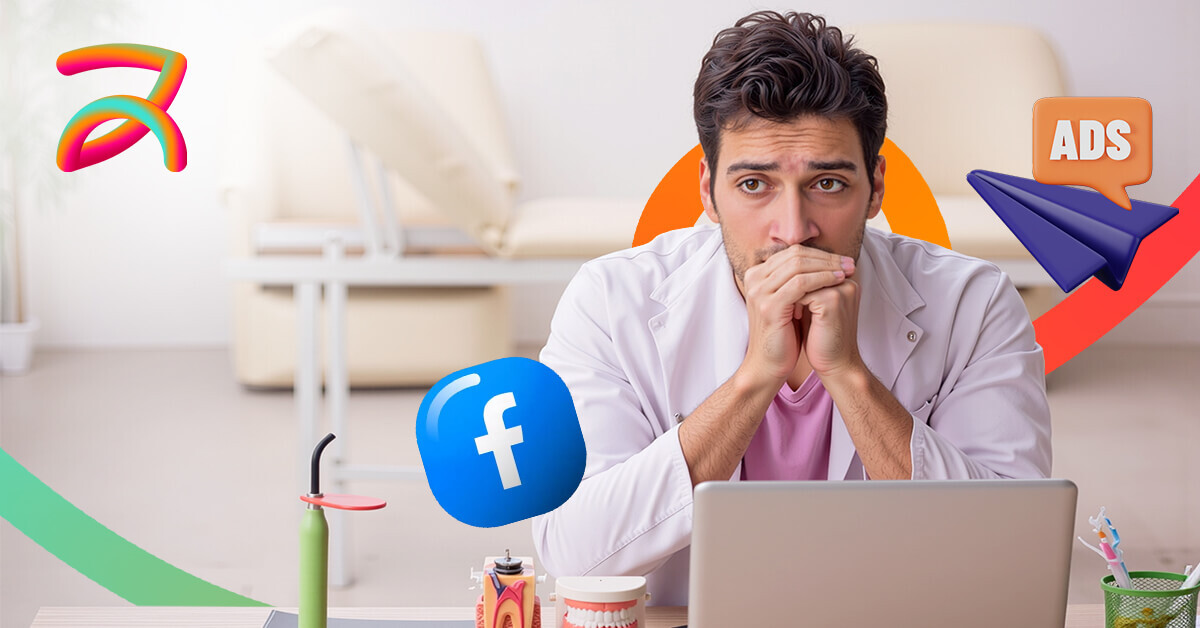
Your Facebook ads for dentists are not converting because of poor landing page design, generic messaging that doesn’t differentiate you from competitors, targeting the wrong audience demographics, untrained front office staff who can’t close phone inquiries, or sending traffic to your homepage instead of service-specific pages. The average conversion rate for dental Facebook ads is 9.83%, but most practices see 2-3% because they’re making critical mistakes in their campaign setup and follow-up process.
Facebook ads can be frustrating when you’re spending money but not seeing patient bookings. You get clicks, maybe even phone calls, but those leads never turn into scheduled appointments. The problem usually isn’t Facebook itself, it’s how you’ve structured your entire conversion funnel from ad to appointment.
With more than 5 years of experience in dental social media management, we’ve discovered that consistent testing and optimization are the key drivers behind scalable growth for brands. This guide reveals the exact conversion killers destroying your Facebook ad ROI and how to fix each one systematically.
In this article, you’ll learn:
- Why Facebook ads get clicks but zero bookings: low purchase intent, mismatched landing pages, and untrained staff lose 70-80% of ad value
- The creative fatigue cycle that kills campaigns after 30 days and how to refresh ads every 3-4 weeks for sustained performance
- Why sending traffic to your homepage instead of service-specific landing pages destroys 60-70% of conversion potential instantly
- How to identify when to optimize struggling campaigns versus killing them: wait 7-14 days and spend 2-3x target CPA before quitting
- The exact targeting, messaging, and retargeting strategies that reduce cost per patient by 40-60% while increasing booking volume
Quick Fixes For Dental Facebook Ads
| Conversion Killer | How It Hurts Your Ads | Quick Fix |
| Sending traffic to homepage | 67% of visitors leave within 10 seconds | Create service-specific landing pages |
| Generic “We’re great dentists” copy | Zero differentiation from 20 competitors in area | Focus on specific problems and transformations |
| Wrong audience targeting | Showing implant ads to 22-year-olds | Use age, income, location filters strategically |
| No pixel installed | Can’t track conversions or retarget visitors | Install Facebook Pixel on all pages immediately |
| Untrained front desk | Lose 40-60% of qualified leads on phone calls | Create call scripts and booking training |
| Creative fatigue after 30 days | CTR drops 50% with same ad creative | Refresh images and copy every 3-4 weeks |
Why are Facebook ads getting clicks but no patient bookings?
Facebook ads get clicks but no patient bookings because users on Facebook have low purchase intent compared to Google searchers, your landing page doesn’t match the ad promise, your front office isn’t converting phone inquiries effectively, or you’re attracting the wrong audience with broad targeting that brings tire-kickers instead of serious patients.
The gap between click and booking is where most dental practices lose 70-80% of their ad spend value.
According to WordStream’s Facebook Ads Benchmarks 2024, dentists have the lowest click-through rate at 1.05% for lead generation campaigns, with an average cost per lead of $76.71. This means you’re paying premium prices for leads that may not be qualified or ready to book, especially compared to search-based advertising where users actively seek dental services.
The Intent Gap Between Facebook and Search Traffic
Facebook users are scrolling their feed to see family photos and funny videos—they’re not actively looking for a dentist right now.
Lower conversion intent means users clicking your ad aren’t in “buy mode” yet. They saw something interesting and clicked, but they’re not experiencing tooth pain or desperately searching for cosmetic dentistry. This creates a natural conversion lag.
- Search ads catch high-intent patients actively looking for solutions right now
- Facebook ads interrupt passive scrollers who might need services eventually
- Expect 3-7 day delay between click and booking for cold Facebook traffic
- Retargeting campaigns convert better by reaching people who already showed interest
Your Landing Page Doesn’t Match Your Ad Promise
During our 5 years of experience, we’ve seen that mismatched messaging between ad and landing page kills about 60% of conversion potential before visitors even read your content.
If your ad talks about “pain-free dental implants” but your landing page shows general dentistry services, people bounce immediately. Your landing page needs to continue the exact conversation started in your ad.
- Ad mentions specific service → Landing page focuses only on that service
- Ad shows before/after photos → Landing page features more transformations
- Ad promises free consultation → Landing page has prominent booking form
- Ad targets local area → Landing page mentions your city and neighborhood
Front Office Isn’t Converting Phone Leads
Getting clicks and calls means your ads work—but untrained staff can destroy your conversion rate instantly.
When potential patients call, your front desk has about 45 seconds to build trust and move toward booking. If they sound rushed, can’t answer basic questions, or make scheduling difficult, you’ve wasted that entire ad spend.
- Train staff on service-specific questions they’ll receive from ad campaigns
- Create booking scripts that overcome common objections confidently
- Track call recordings to identify why leads aren’t converting to appointments
- Set clear goals for front desk conversion rates (minimum 40-50% of qualified calls)
Why are my Facebook ads suddenly not converting?
Your Facebook ads suddenly stopped converting because of creative fatigue (same ads running too long), iOS tracking limitations reducing your audience targeting accuracy, increased competition in your local market driving up costs, seasonal demand shifts, or algorithm changes that affected your campaign delivery.
Most conversion drops happen after 30-45 days when your audience has seen your creative multiple times and stops engaging.
According to Facebook advertising research, creative fatigue is real—ads lose effectiveness if creative isn’t refreshed regularly. When the same people see your ad repeatedly without taking action, Facebook’s algorithm stops showing it as frequently, and your performance metrics decline rapidly.
Creative Fatigue Destroys Performance After 30 Days
Your audience gets tired of seeing the same ad creative over and over, causing engagement to plummet.
Facebook shows your ads to the same pool of local prospects repeatedly. After they’ve seen your “teeth whitening special” five times without clicking, they start mentally tuning it out. Your CTR drops, costs increase, and conversions disappear.
- Refresh ad images every 3-4 weeks with new photos or graphics
- Test 3-5 different headlines rotating through your campaign
- Change your offer periodically to create urgency and novelty
- Monitor frequency metric in Ads Manager (keep below 3.0 for cold audiences)
iOS Privacy Changes Killed Your Targeting
Apple’s privacy updates made it harder for Facebook to track users and optimize your campaigns effectively.
Since iOS 14.5, many iPhone users opted out of tracking, which means Facebook has less data about who converts from your ads. This forces the algorithm to work with incomplete information, reducing targeting accuracy by 30-40% for some campaigns.
- Use broader targeting since detailed targeting is less effective now
- Focus on Advantage+ campaigns that let Facebook’s AI find converters
- Implement Conversions API alongside Facebook Pixel for better tracking
- Increase audience sizes to 500,000+ for better algorithm learning
Seasonal Demand Shifts Impact Dental Services
Different dental services have natural busy and slow seasons that affect conversion rates predictably.
Cosmetic dentistry sees spikes before weddings (spring/summer) and major holidays, while general dentistry stays steadier. If you’re running the same campaign year-round, seasonal interest changes will impact your conversions dramatically.
- Align campaigns with seasonal demand for specific services
- Promote teeth whitening heavily before prom, weddings, graduation season
- Push insurance benefits in October-December when people have unused coverage
- Adjust budgets based on historical performance by month and quarter
What is the 20 rule on Facebook ads?
The 20% rule on Facebook ads was a previous policy requiring that text overlay on ad images couldn’t exceed 20% of the image area, but Facebook officially removed this rule in 2020, though they still recommend using minimal text for better ad delivery and lower costs.
Ads with less text in images generally perform better because they look more native to the Facebook feed and generate higher engagement rates.
According to Facebook’s current advertising guidelines and best practices documentation, while the strict 20% text rule no longer exists, the platform’s algorithm still favors images with less text. Ads with text-heavy images may get reduced reach or higher costs per result.
Why Less Text Still Matters for Ad Performance
Even without the strict rule, images with minimal text convert better and cost less to run.
Facebook users scroll quickly through their feeds. Text-heavy images feel like obvious ads and get ignored, while clean visuals with emotional appeal stop the scroll. The actual ad copy below the image should do the heavy lifting.
- Use text overlays strategically for key numbers or offers only
- Put detailed information in ad copy below the image instead
- Test text-free images against text-heavy versions to compare performance
- Focus on emotional imagery that tells a story without words
What Text Exceptions Still Apply
Some types of text on images don’t hurt your ad performance as much as others.
Product images with packaging text, book covers, or screenshots naturally contain text. Facebook’s algorithm recognizes these as necessary rather than excessive promotional text that hurts user experience.
- Product packaging text doesn’t count against you significantly
- Screenshots of apps or websites are acceptable with text visible
- Logos and watermarks are fine in moderation
- Before/after comparison text labels work well for dental transformations
Testing Your Ad Image Text Ratio
You can still check if your images have too much text using Facebook’s preview tool.
While Facebook won’t reject your ad anymore, you’ll see warnings if text might reduce delivery. These warnings help you optimize before wasting budget on underperforming creative.
- Upload images to Ads Manager to see text density feedback
- Test cleaner versions if you get “too much text” warnings
- Monitor delivery metrics for text-heavy ads vs. clean images
- Use text in carousel cards strategically where it adds context
Why are my ads not converting to sales?
Your ads aren’t converting to sales because you’re targeting people who can’t afford your services, using generic copy that doesn’t address specific patient pain points, lacking urgency or clear calls-to-action, or failing to nurture leads through retargeting campaigns after initial engagement. The average cost per lead for dentists on Facebook is $76.71, but conversion from lead to patient requires strategic follow-up that most practices neglect.
According to LocaliQ’s Facebook Advertising Benchmarks 2025, while dentists can achieve a 9.83% conversion rate on Facebook ads, most practices fall far below this because they optimize for clicks rather than actual patient bookings and revenue.
You’re Targeting Based on Demographics, Not Intent
Just because someone lives in your area doesn’t mean they need dental work right now.
Broad targeting like “everyone within 10 miles” wastes money showing ads to people who just visited the dentist last week or can’t afford your services. You need to layer targeting to find qualified prospects.
- Target life events like new marriages, new parents, people who recently moved
- Use income targeting for high-ticket services like implants and cosmetic work
- Layer interests related to health, wellness, and self-improvement
- Exclude recent customers if you have their email list uploaded
Your Ad Copy Is Generic and Forgettable
Saying “We’re a family dental practice committed to your smile” makes you invisible among competitors.
Every dentist in your area says the same things. Your ad copy needs to speak directly to specific fears, desires, and situations that resonate emotionally with your ideal patient.
- Address specific pain points: “Tired of dentists who make you feel judged?”
- Make bold promises: “Pain-free dentistry or your money back”
- Use social proof: “Join 500+ families who trust us with their smiles”
- Create urgency: “Only 3 consultation spots left this week”
You’re Not Retargeting Engaged Audiences
Most people don’t book on the first visit to your website, you need multiple touchpoints.
For practices seeking help with strategic Facebook advertising that converts, professional social media management for dentists can set up complete retargeting funnels that follow up with website visitors, video viewers, and people who engaged with your content but didn’t book yet.
Someone who watched 75% of your video about dental implants showed serious interest but wasn’t ready to commit. Retargeting keeps you top-of-mind when they’re finally ready to book.
- Create custom audiences from website visitors in last 30-90 days
- Target video viewers who watched at least 50% of your content
- Exclude recent converters so you’re not wasting budget on existing patients
- Use softer messaging in retargeting ads focused on overcoming objections
Is my landing page killing my Facebook ad conversions?
Your landing page is killing your Facebook ad conversions if it loads slowly (over 3 seconds), doesn’t match your ad messaging, requires too many form fields, sends visitors to your homepage instead of service-specific pages, or lacks clear calls-to-action and social proof elements like reviews and before-after photos. According to dental marketing research, sending people from a dental implants Facebook ad to the website’s homepage destroys 60-70% of conversion potential immediately.
After auditing 100+ dental practices and campaigns, our data shows that fixing landing page design and messaging improves conversion rates by 150-300% without spending an extra dollar on ads.
You’re Sending Traffic to Your Homepage
Your homepage tries to appeal to everyone and ends up converting nobody from paid traffic.
When someone clicks an ad about teeth whitening and lands on a homepage showing all your services, they get confused and overwhelmed. They have to search for the information they wanted, and most people just leave instead.
- Create dedicated landing pages for each service you advertise
- Match landing page headline to your ad headline exactly
- Remove main navigation to prevent visitors from wandering off
- Focus entire page on one service with one clear next step
Your Landing Page Loads Too Slowly
Every extra second of load time costs you conversions exponentially.
Mobile users on Facebook expect instant page loads. If your landing page takes 5+ seconds to load (common with bloated WordPress sites), 40-50% of your clicks will bounce before they even see your content.
- Optimize images to under 200KB each without losing quality
- Use fast hosting specifically designed for conversion landing pages
- Remove unnecessary plugins and scripts slowing down load time
- Test mobile speed using Google PageSpeed Insights (aim for 2-3 seconds)
You’re Asking for Too Much Information Upfront
Long contact forms create friction that kills conversions before they happen.
People scrolling Facebook aren’t ready to fill out a 10-field medical history form. They want to learn more and maybe book a consultation—that’s it. Every additional form field reduces conversion rates by 5-10%.
- Ask for name, phone, and preferred date only in initial form
- Collect detailed information later after they’ve committed to appointment
- Offer click-to-call buttons prominently for mobile users
- Test shorter forms against longer ones to quantify improvement
There’s No Social Proof or Trust Signals
Strangers seeing your ad for the first time need reasons to trust you immediately.
Without reviews, testimonials, before-after photos, or credentials visible on your landing page, visitors have no reason to believe you’re better than the 10 other dentists they could choose from.
- Display Google star rating prominently at top of landing page
- Include 3-5 specific patient testimonials with photos if possible
- Show before-after transformations relevant to the advertised service
- Mention years in practice and professional credentials/memberships
For practices looking to improve their entire paid advertising strategy across platforms, proven social media management services can design high-converting landing pages, write persuasive ad copy, and optimize campaigns to reduce cost per patient while increasing booking volume.
If you’ve fixed the technical issues with your campaigns but still want proven frameworks that consistently fill appointment schedules, you’ll find exactly what you need in Facebook advertising for dentists that books patients. It breaks down the complete booking system from ad to appointment confirmation.
How long should you wait before giving up on underperforming Facebook ads?
You should wait 7-14 days and spend at least 2-3 times your target cost per acquisition before giving up on underperforming Facebook ads, as the learning phase requires approximately 50 conversion events for Facebook’s algorithm to optimize delivery properly. Shutting down campaigns too early prevents the algorithm from gathering enough data to identify which audiences actually convert for your practice.
According to Facebook’s advertising optimization guidelines and dental marketing case studies, campaigns need time to exit the learning phase and stabilize. Most practices panic and kill campaigns after 2-3 days without conversions, which guarantees failure by never letting the system optimize.
Understanding the Facebook Learning Phase
Facebook needs data to figure out who’s most likely to convert from your ads.
When you launch a new campaign, Facebook shows your ads to a broad sample of your target audience. It tracks who engages, who clicks, and who converts. This data teaches the algorithm which specific user types to focus on, but it takes time to gather meaningful patterns.
- Learning phase requires 50 conversion events within 7-day period
- Expect higher costs initially as Facebook tests different audiences
- Avoid making changes during learning or you’ll reset the process
- Let campaigns run 7-14 days minimum before evaluating performance
When to Kill a Campaign Early
Some campaigns are clearly failing and should be stopped before wasting more budget.
If you’re spending $50+ per lead when your target is $75 and you’ve already spent $1,000 with zero bookings, something is fundamentally wrong. Don’t throw good money after bad—fix the underlying issue first.
- Zero conversions after spending 3x your target CPA means major problems
- CTR below 0.5% indicates your creative or targeting is completely off
- Cost per click over $15 suggests you’re competing in oversaturated market
- Landing page bounce rate over 80% means messaging mismatch or technical issues
How to Optimize Instead of Quitting
Before killing campaigns, try systematic improvements to fix performance issues.
Our expertise has been featured in top digital marketing magazines for delivering top-class dental advertising solutions to our clients. Most “failed” campaigns can be rescued with strategic adjustments.
- Refresh creative with new images, headlines, and copy angles
- Narrow targeting if you’re reaching too broad an audience
- Test different offers like free consultation vs. limited-time discount
- A/B test landing pages to find messaging that resonates better
Setting Realistic Expectations for Campaign Performance
Not every campaign will deliver instant results—some services have longer sales cycles.
General dental cleanings might convert within days, but dental implants (costing $3,000-6,000) require multiple touchpoints over weeks or months. Your patience and follow-up strategy need to match your service complexity and price point.
- Low-cost services ($200-500) should convert within 7-14 days
- Mid-tier services ($500-2,000) may take 14-30 days to convert
- High-ticket procedures ($2,000+) often require 30-90 days and retargeting
- Track full patient journey from first click to booked appointment, not just leads
If your campaigns have been running for weeks without clear direction on whether to optimize or abandon them, understanding the bigger picture helps.
Final Thoughts
Your Facebook ads aren’t failing because the platform doesn’t work—they’re failing because of specific, fixable problems in your conversion funnel. From mismatched landing pages to untrained staff to generic messaging, most dental practices are making the same preventable mistakes that destroy their ad ROI.
The good news is that every conversion killer we’ve covered has a solution. Better targeting brings qualified leads. Service-specific landing pages convert clicks into bookings. Trained front office staff close phone inquiries. Strategic retargeting captures people who weren’t ready on first visit.
Running profitable Facebook ad campaigns while managing a busy dental practice takes specialized knowledge of platform algorithms, landing page psychology, conversion optimization, and patient acquisition strategy. Most dentists don’t have time to master these skills while treating patients.
🎯 How Buzzz Can Help You?
Discover the specific conversion killers destroying your ROI, we’ll show you exactly how we’ve helped dental practices reduce cost per patient while doubling monthly bookings.
Schedule Your Facebook Strategy Appointment →