
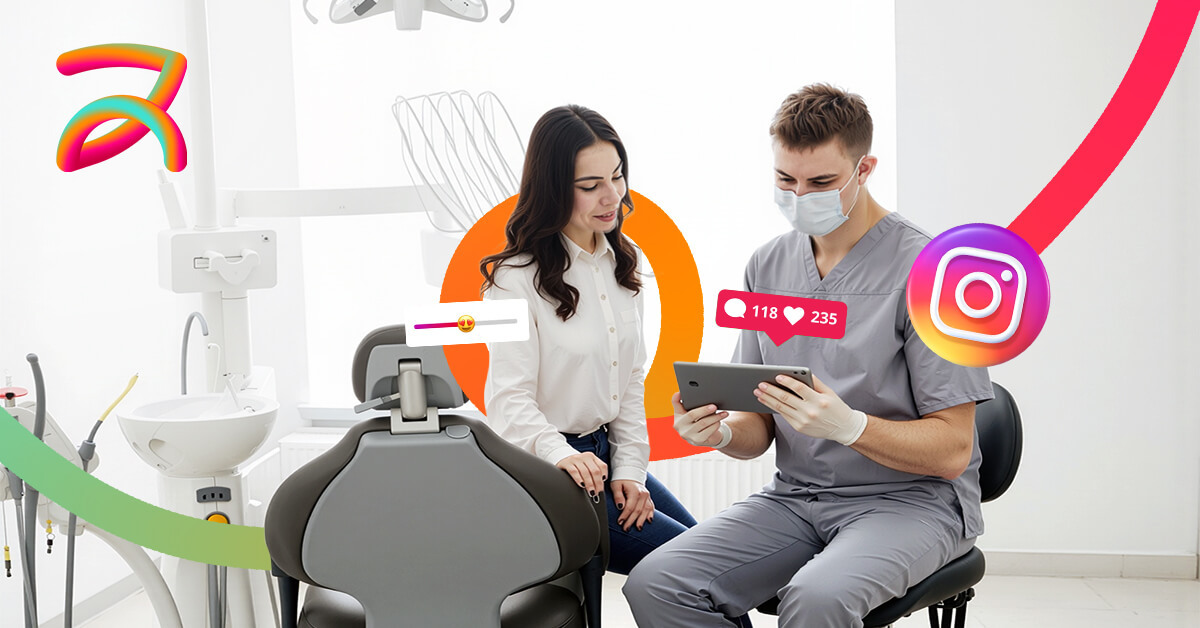
Dental Instagram ads target high-value patients using advanced demographic filters that focus on age 35-65 with household incomes above $75,000, interest-based targeting for cosmetic dentistry and wellness enthusiasts, geographic radius targeting within 5-15 miles of your practice, lookalike audiences modeled after your existing high-value patients, retargeting campaigns for website visitors who viewed premium service pages, and life event targeting for recently engaged couples or professionals seeking smile transformations.
These precision targeting capabilities let dentists spend ad budgets exclusively on prospects most likely to afford and book high-ticket procedures like dental implants, veneers, and full-mouth reconstruction.
Most dental practices waste Instagram ad budgets showing implant ads to 22-year-olds or promoting veneers to people who can’t afford them. They target “everyone nearby” and wonder why their $500 ad spend generated zero $5,000 treatment bookings.
From more than 5 years of experience in dental social media management, we’ve discovered that consistent testing and optimization are the key drivers behind scalable growth for brands.
This guide reveals the exact Instagram targeting strategies that fill practices with patients who say yes to treatment plans, not just consultations they ghost.
In this article, you’ll learn:
- How income targeting works: Meta’s demographic filters let you target top 10-25% earners, automatically excluding prospects who can’t afford $5,000-20,000 treatments
- Why clicks don’t equal bookings: 70-80% of leads lost between click and booking due to landing page mismatches, slow follow-up, and poor phone scripts
- Budget requirements for results: $50-100 daily ($1,500-3,000 monthly) minimum for premium services, expecting $100-200 cost per lead in competitive markets
- Retargeting multiplies conversions: Website visitors convert 3-5x better than cold traffic when retargeted with objection-focused ads and limited-time offers
- Video formats dominate performance: Reels and video testimonials outperform static images by 3-5x for engagement and booking conversions in cosmetic dentistry
High Value Dental Patient Targeting Strategies for Instagram
| Service Type | Target Age | Income Filter | Interest Targeting | Expected Cost Per Lead | Conversion to Treatment |
| General Dentistry | 25-65 | All incomes | Dental care, family health | $30-60 | 40-50% |
| Teeth Whitening | 25-55 | $50k+ | Weddings, beauty, cosmetics | $20-40 | 50-60% |
| Invisalign | 25-45 | $60k+ | Orthodontics, professional appearance | $50-90 | 30-40% |
| Veneers/Cosmetics | 30-60 | $75k+ | Luxury lifestyle, beauty, confidence | $80-150 | 25-35% |
| Dental Implants | 45-70 | $75k+ | Health, wellness, quality of life | $100-200 | 20-30% |
How Instagram Ads Target Patients Who Can Afford Expensive Dental Work?
Instagram ads target patients who can afford expensive dental work by filtering audiences based on household income percentiles (top 10-25%), layering interests like luxury brands and high-end fitness, targeting zip codes with higher median incomes, using behaviors like frequent travelers or online luxury shoppers, and building lookalike audiences from your existing cosmetic and implant patients who accepted high-value treatment plans.
The Meta Ads platform allows dentists to exclude lower-income demographics entirely, ensuring every ad dollar reaches prospects with financial capacity for premium procedures.
According to dental advertising research, filtering by age, income, and family status matches ads with the right audience. For example, targeting parents for pediatric services or high-income earners for cosmetic cases. This precision targeting reduces wasted ad spend significantly and improves cost-per-acquisition for high-ticket treatments.
Income-Based Demographic Targeting
Meta’s income filters let you show ads exclusively to households with financial capacity for premium dental work.
Instagram uses third-party data sources to estimate household income based on zip codes, purchasing behavior, and lifestyle indicators. You can target the top 10%, top 25%, or top 50% of earners in your geographic area, automatically filtering out prospects unlikely to afford $5,000-20,000 treatment plans.
- Top 10% income earners: Ideal for full-mouth reconstruction, All-on-4 implants, extensive cosmetic work
- Top 25% income earners: Good for single implants, veneers, Invisalign treatment
- Top 50% income earners: Appropriate for whitening, bonding, moderate cosmetic procedures
- All income levels: General dentistry, emergency services, cleanings
Interest and Behavior Layering
Combine income filters with interests that signal affluence and appearance-consciousness for maximum precision.
People interested in luxury brands, high-end fitness (CrossFit, Peloton, boutique studios), fine dining, travel, and professional networking tend to invest more in their appearance—including their smiles. Layering these interests with income targeting creates ultra-qualified audiences.
- Luxury lifestyle interests: High-end fashion, luxury cars, premium hotels, fine dining
- Appearance-focused: Beauty products, cosmetic procedures, skincare, fitness
- Professional development: Leadership, executive coaching, networking events
- Health-conscious: Wellness, organic food, preventive healthcare, longevity
Geographic and Zip Code Targeting
Target neighborhoods and zip codes with median incomes that match your ideal patient profile.
During our 5 years of experience, we’ve seen that practices targeting a tight 2-15 mile radius around affluent neighborhoods generate leads at 40-60% lower cost-per-acquisition than those targeting entire cities indiscriminately.
- Research local income data: Identify zip codes with median household incomes above $100k
- Exclude lower-income areas: Save budget by removing zip codes unlikely to afford premium work
- Focus on professional districts: Target business districts during work hours for executives
- Adjust radius by density: 2-5 miles urban, 5-10 miles suburban, 10-15 miles rural
Why Do Users Click on Dental Instagram Ad But Not Book an Appointment?
People click dental Instagram ads but not book appointment because the landing page doesn’t match the ad promise, there’s no clear next step or booking mechanism, the price isn’t transparent causing sticker shock during consultation, the form asks for too much information upfront scaring prospects away, phone follow-up is slow or non-existent, or the ad attracted curious browsers rather than high-intent patients through poor targeting.
The gap between click and booking is where most practices lose 70-80% of their ad investment.
According to Meta advertising best practices, Instagram ads should direct prospects to targeted landing pages with clear calls-to-action rather than generic homepages. The landing page should continue the exact conversation started in the ad, with prominent booking forms and click-to-call buttons designed for mobile users.
Landing Page Mismatch Kills Conversions
When your ad mentions dental implants but the landing page shows all services, prospects leave immediately.
The #1 conversion killer is sending Instagram traffic to your homepage or a generic “services” page. People expect to land on a page specifically about the service they clicked—implants, veneers, Invisalign—with detailed information, pricing indicators, and easy booking.
- Ad specificity: If ad mentions “$99 whitening special,” landing page must feature that offer prominently
- Visual continuity: Use same images or similar aesthetic from ad to landing page
- Single service focus: Remove navigation, focus entire page on one treatment
- Mobile optimization: 80% of Instagram users are mobile—test on phones first
Missing Urgency and Clear Next Steps
Ads without time pressure let prospects procrastinate indefinitely, and they never return.
High-value patients need compelling reasons to book today rather than “thinking about it.” Limited-time offers, availability scarcity, or seasonal positioning (whitening before wedding season, benefits expiring) drive immediate action rather than browsing.
- Countdown timers: “Only 3 consultation slots left this week”
- Limited-time pricing: “$500 off Invisalign – offer ends Friday”
- Seasonal urgency: “Get summer-ready with teeth whitening”
- Benefits deadline: “Use your 2025 dental insurance before December 31”
Front Office Follow-Up Failures
Getting clicks and leads means your ads work, but untrained staff destroy conversion rates instantly.
After auditing 100+ dental practices and campaigns, our data shows that fixing front office phone scripts and follow-up timing improves conversion rates by 150-300% without spending an extra dollar on ads. Most leads get followed up 24-48 hours later when enthusiasm has cooled—high-value patients expect responses within 2 hours.
- 2-hour response window: Call/text leads within 2 hours while interest is hot
- Train for high-value objections: Staff need scripts for cost concerns, financing options
- Multiple contact attempts: Try 3-5 times before giving up on leads
- CRM tracking: Document every interaction to identify where leads fall off
If your Instagram ads generate clicks but not bookings, the problem usually isn’t the ads, it’s your conversion funnel.
For practices struggling with this exact issue in Facebook ads too, they can try exploring the reasons why Facebook ads for dentists are not converting which reveals the systematic conversion killers destroying ROI beyond just targeting.
How Much to Spend on Instagram Ads to Get High-Value Cosmetic Patients?
To get high-value cosmetic patients from Instagram ads, budget $50-100 daily ($1,500-3,000 monthly) for single-location practices targeting one premium service, expecting 10-30 qualified leads monthly at $100-200 cost per lead for cosmetic and implant campaigns.
Higher budgets ($100-200 daily) work for competitive markets or practices offering multiple premium services simultaneously. This investment allows campaigns to exit Meta’s learning phase (requires 50 conversions) and gives the algorithm enough data to optimize for high-value patient types.
According to dental advertising benchmarks, cost-per-lead generally falls between $20 and $60 for general dentistry, rising to $80-150 for premium cosmetic services and implants in competitive markets. Your budget should align with patient lifetime value. A single implant patient worth $5,000-15,000 justifies higher acquisition costs than general dentistry patients.
Budget Based on Service Value
Your Instagram ad budget should reflect the revenue potential of patients you’re attracting.
If you’re advertising All-on-4 implants that generate $20,000-40,000 per patient, you can afford $500-1,000 cost-per-acquisition. If you’re promoting teeth whitening at $500, your maximum acquisition cost must be proportionally lower—typically 10-20% of service value.
- Teeth whitening ($400-800 service): Budget $30-50 daily, accept $40-80 cost per booking
- Invisalign ($3,000-8,000 service): Budget $50-75 daily, accept $150-250 cost per booking
- Veneers ($10,000-30,000 service): Budget $75-150 daily, accept $300-600 cost per booking
- Dental implants ($15,000-50,000 service): Budget $100-200 daily, accept $500-1,000 cost per booking
The Learning Phase Budget Requirement
Meta’s algorithm needs 50 conversion events within 7 days to optimize effectively, so budget accordingly.
Campaigns that don’t hit this threshold stay in “learning” mode indefinitely, delivering inconsistent results and higher costs. For cosmetic dentistry with longer sales cycles, this means budgeting enough to generate 50+ leads (not just bookings) within the first week.
- Minimum daily budget: $50 for learning phase completion within 7-10 days
- Ideal daily budget: $75-100 for faster optimization and better data
- Testing phase: Start with $50 daily for 14 days before scaling
- Scaling rule: Increase budget by maximum 20% every 3-4 days once profitable
Geographic Market Competition
Your required budget varies dramatically based on local competition and market saturation.
With a combined dental marketing experience of more than 5 years, we cater to practices by analyzing local market dynamics before recommending budgets. A practice in rural Montana might dominate at $30 daily, while Manhattan dentists need $150-200 daily just to compete for visibility.
- Low competition markets: $30-50 daily sufficient for premium service leads
- Medium competition: $50-100 daily for consistent high-value patient flow
- High competition metros: $100-200 daily minimum to compete effectively
- Seasonal adjustments: Increase 30-50% during peak seasons (wedding season, December benefits rush)
How to Target People who Visited the Website But Didn’t Book the Consultation?
You can target people who visited your website but didn’t book consultations using Meta Pixel retargeting campaigns that track specific page visitors (like dental implant or veneers pages), create custom audiences from these visitors, then show them reminder ads with special offers or urgency messaging, video testimonials from satisfied patients, or free consultation promotions designed specifically to overcome initial objections.
Retargeting converts 3-5x better than cold traffic because these prospects already know your practice and showed interest, they just needed more touchpoints to commit.
According to Instagram advertising research, website visitors and retargeting campaigns represent “warm” audiences significantly more likely to convert than cold audiences. By targeting users with life events like “Newly Engaged” or “Upcoming Birthday,” practices can proactively position cosmetic services at perfect timing moments.
Setting Up Meta Pixel for Retargeting
The Facebook Pixel is code installed on your website that tracks visitor behavior and enables retargeting.
Without Pixel tracking, you’re flying blind—unable to retarget website visitors or measure which ads drive actual bookings. The Pixel tracks which pages people visit, how long they stay, and whether they complete desired actions like form submissions or phone clicks.
- Install on all pages: Every page needs Pixel code, especially service and contact pages
- Track specific events: Form submissions, phone clicks, chat initiations, appointment confirmations
- Create page-based audiences: People who viewed implants page, veneers page, pricing page
- Set audience windows: 30 days for general services, 90-180 days for high-value procedures
Retargeting Campaign Strategy
Different prospects need different messaging based on what they viewed and how close they came to booking.
Someone who viewed your implants page, read testimonials, and looked at pricing is much warmer than someone who just hit your homepage and bounced. Segment retargeting audiences by engagement level and customize messaging accordingly.
- Page visitors (30-90 days): “Still considering dental implants? Schedule your free consultation”
- Form abandoners: “Complete your appointment request—we saved your information”
- Phone clickers who didn’t call: “Call now for same-day appointments available”
- Multiple page viewers: “You’ve been researching smile makeovers—let’s talk about your goals”
The Retargeting Ad Creative Difference
Retargeting ads should acknowledge familiarity and address specific objections preventing booking.
Our expertise has been featured in top digital marketing magazines for delivering top-class dental retargeting solutions to clients. The most effective retargeting ads reference the prospect’s previous interest: “Still thinking about Invisalign?” or “Ready to transform your smile?”
- Objection-focused: Address cost concerns with financing options prominently displayed
- Social proof heavy: Testimonials and reviews from patients who had same procedure
- Limited-time incentive: “$200 off your consultation if you book this week”
- Multiple creative variations: Test 3-5 different angles to see what converts
For dentists wanting professional help implementing complete retargeting funnels that nurture website visitors through to booked appointments, professional social media management for dentists can set up Pixel tracking, create segmented audiences, design conversion-optimized retargeting creative, and manage campaigns that systematically convert warm traffic into paying patients.
What Instagram Ad Formats Work Best for Attracting Cosmetic Dentistry Patients?
Instagram ad formats that work best for attracting cosmetic dentistry patients include short-form video Reels (15-30 seconds) showcasing before-after transformations with trending audio, carousel ads displaying multiple smile makeover results with swipeable progression, Instagram Stories ads with interactive poll stickers asking about smile confidence, testimonial videos featuring real patients describing their experience, and single-image ads featuring dramatic before-after comparisons with clear pricing and call-to-action overlays.
Video formats consistently outperform static images by 3-5x for engagement and conversion in cosmetic dentistry advertising.
According to Instagram advertising research for dental practices, the best targeted dental ads include a mix of videos, carousel ads, and Stories ads, all of which grab attention effectively. Videos showcase practice personality and patient testimonials, carousels display multiple services, and Stories ads quickly engage viewers with dynamic content.
Video Reels for Maximum Reach
Reels receive Instagram’s highest algorithmic boost, reaching non-followers and generating awareness efficiently.
Short-form vertical video performs exceptionally well for cosmetic dentistry because it shows the human transformation—not just teeth, but confidence and emotion. A 15-second Reel showing a patient’s reaction to seeing their new smile often outperforms static before-afters by 500-1000%.
- Optimal length: 15-30 seconds maximum for highest completion rates
- Hook first 3 seconds: Start with arresting visual or bold claim
- Trending audio: Use popular sounds to boost discovery algorithm
- Text overlays: 85% watch without sound—add captions explaining transformation
Carousel Ads for Comprehensive Storytelling
Multi-image carousels let you show treatment progression, multiple results, or service comparisons.
Carousels work beautifully for cosmetic dentistry because they can show: 1) Before photo, 2) Midpoint transformation, 3) Final result, 4) Patient testimonial quote, 5) Pricing/CTA. Each swipe counts as engagement, signaling quality content to the algorithm.
- 5-8 slides optimal: Enough for story, short enough for completion
- Progressive reveal: Build anticipation showing transformation stages
- Mix content types: Photos, graphics with text, testimonial quotes, pricing slide
- Strong CTA final slide: “Book your free consultation” with phone number
Before-After Static Images
Single before-after comparisons still work if executed with professional quality and compelling copy.
While not as engaging as video, well-executed before-after images with split-screen comparisons, clear lighting, and professional photography convert browsers into leads. The key is making the transformation immediately obvious and emotionally compelling.
- Professional photography: Consistent lighting, angles, and background
- Clear labeling: “Before” and “After” text overlays prominently displayed
- Include timeframe: “6 months transformation” or “Same-day results”
- Patient consent always: HIPAA-compliant releases for all patient photos
For comprehensive strategies managing Instagram ad creative across multiple formats while optimizing for maximum patient acquisition ROI, comprehensive social media management services can produce professional video content, design high-converting carousels, A/B test creative variations, and coordinate campaigns that systematically fill your schedule with high-value cosmetic patients.
Final Thoughts
Instagram ads offer dental practices unprecedented ability to target high-value patients with surgical precision. While Facebook and Google reach broad audiences, Instagram’s visual nature and sophisticated targeting let you show smile transformation content exclusively to affluent prospects ages 35-65 within 10 miles who follow luxury brands and recently got engaged. The exact demographics most likely to invest $10,000-40,000 in cosmetic dentistry.
Most dental practices struggle with Instagram ads because they target too broadly wasting budgets on unqualified clicks, send traffic to generic homepages killing conversions, lack retargeting systems losing 90% of interested prospects, create amateur content that doesn’t stop the scroll, or can’t track which ads drive actual revenue. Building profitable Instagram campaigns requires platform expertise and continuous optimization that busy practitioners don’t have time for.
🎯 How Buzzz Can Help You?
Discover how we create scroll-stopping video creative, and build complete conversion funnels that turn ad spend into predictable $10,000-50,000 case acceptance rates.
Book Instagram Ads Strategy Appointment →